Authenticate
Per-workspace identity
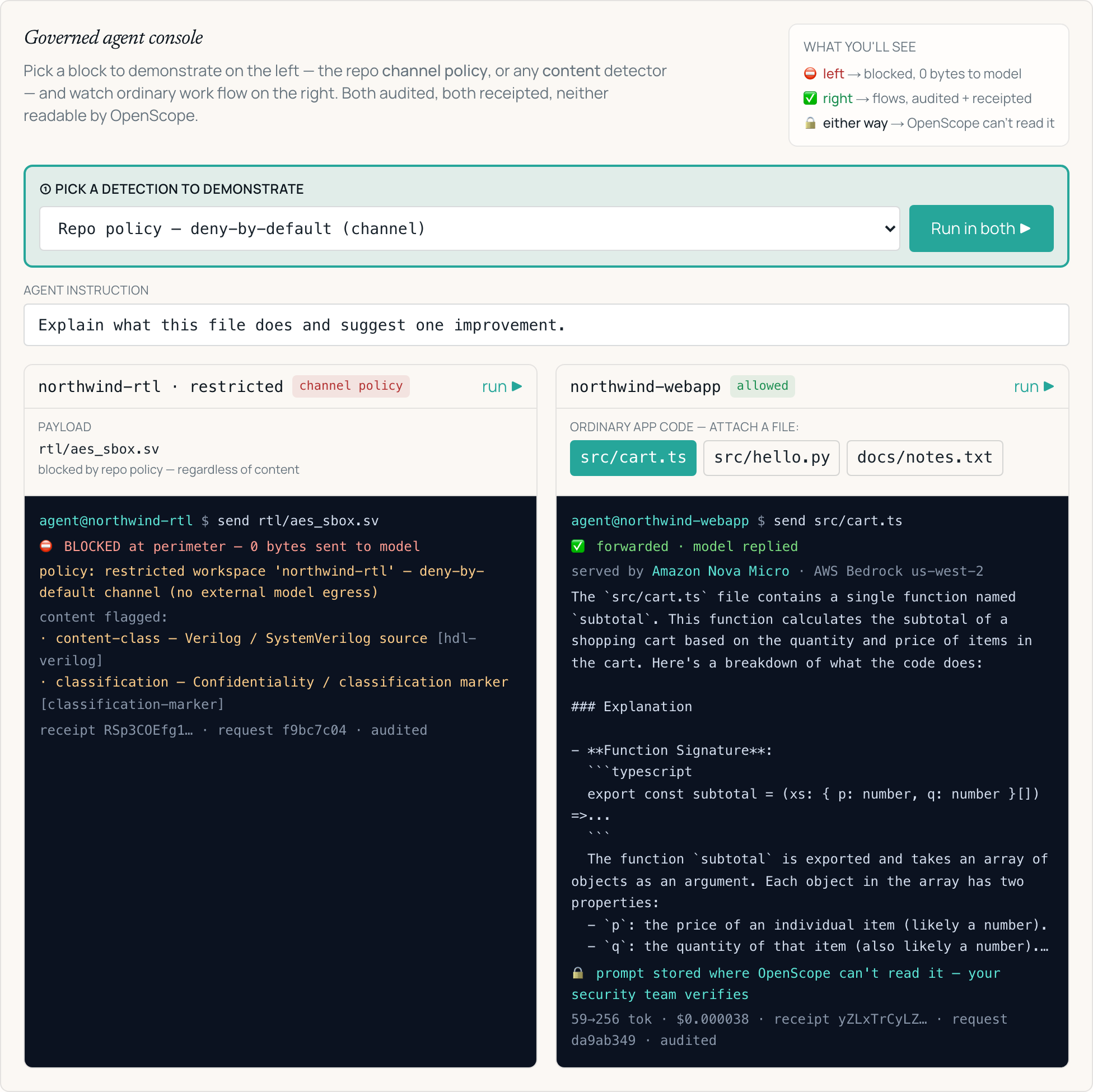
Each agent call carries a key and a workspace label. A restricted repo is a deny-by-default channel, nothing from it reaches an external model, regardless of content.
See everything your coding agents send, and stop what shouldn't leave. Point Cursor, Claude Code, opencode, or Codex at the OpenScope AI Router and every call flows through an in-VPC gateway: content-aware DLP at the edge, per-model metering, and a signed receipt, structurally unable to read your prompts, a property you can validate, not take on faith.
No new tool to learn for your engineers, they keep Cursor, Claude Code, opencode, or Codex. You just change the base URL to the router, and every request is governed and audited before it can leave your perimeter.
Each agent call carries a key and a workspace label. A restricted repo is a deny-by-default channel, nothing from it reaches an external model, regardless of content.
The full payload is scanned in plaintext at the router (TLS terminates here, a reverse proxy, not a man-in-the-middle). Proprietary IP, classification markers, and secrets are blocked before the prompt leaves your VPC.
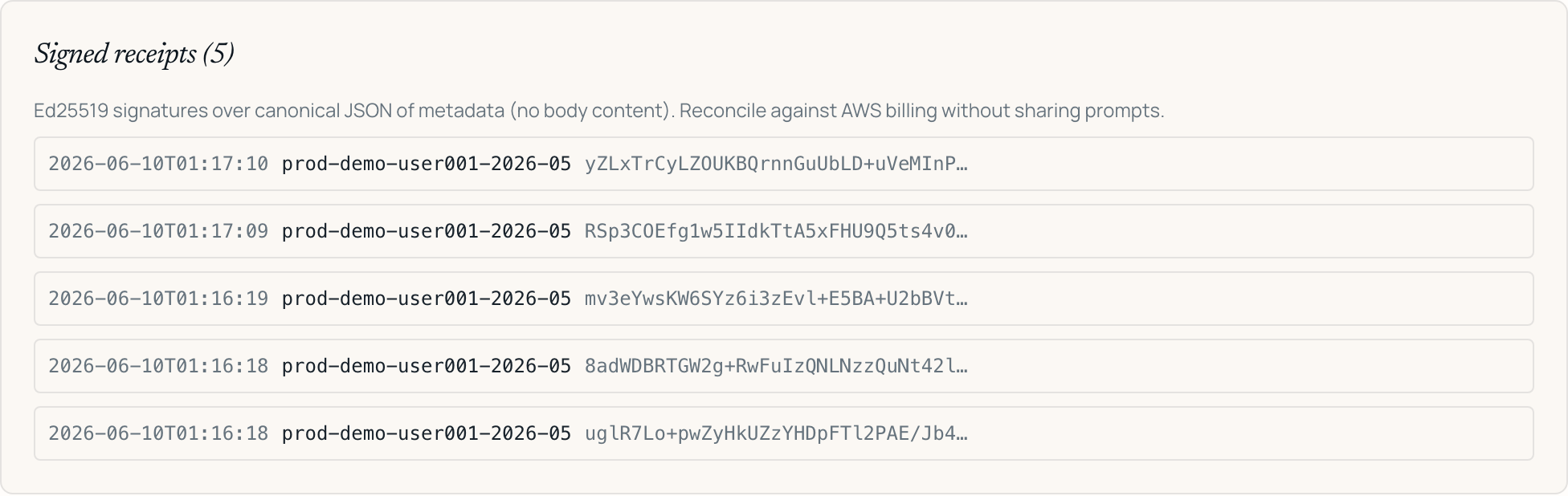
Allowed calls go to the model in your own account, metered per model with cost. Every request produces an Ed25519-signed receipt and a metadata audit row, no prompt body required to reconcile.
Three layers run on every payload. A restricted repo is blocked outright; the content layers are the backstop that still catches the same IP when a file is moved, renamed, or pasted from an allowed repo.
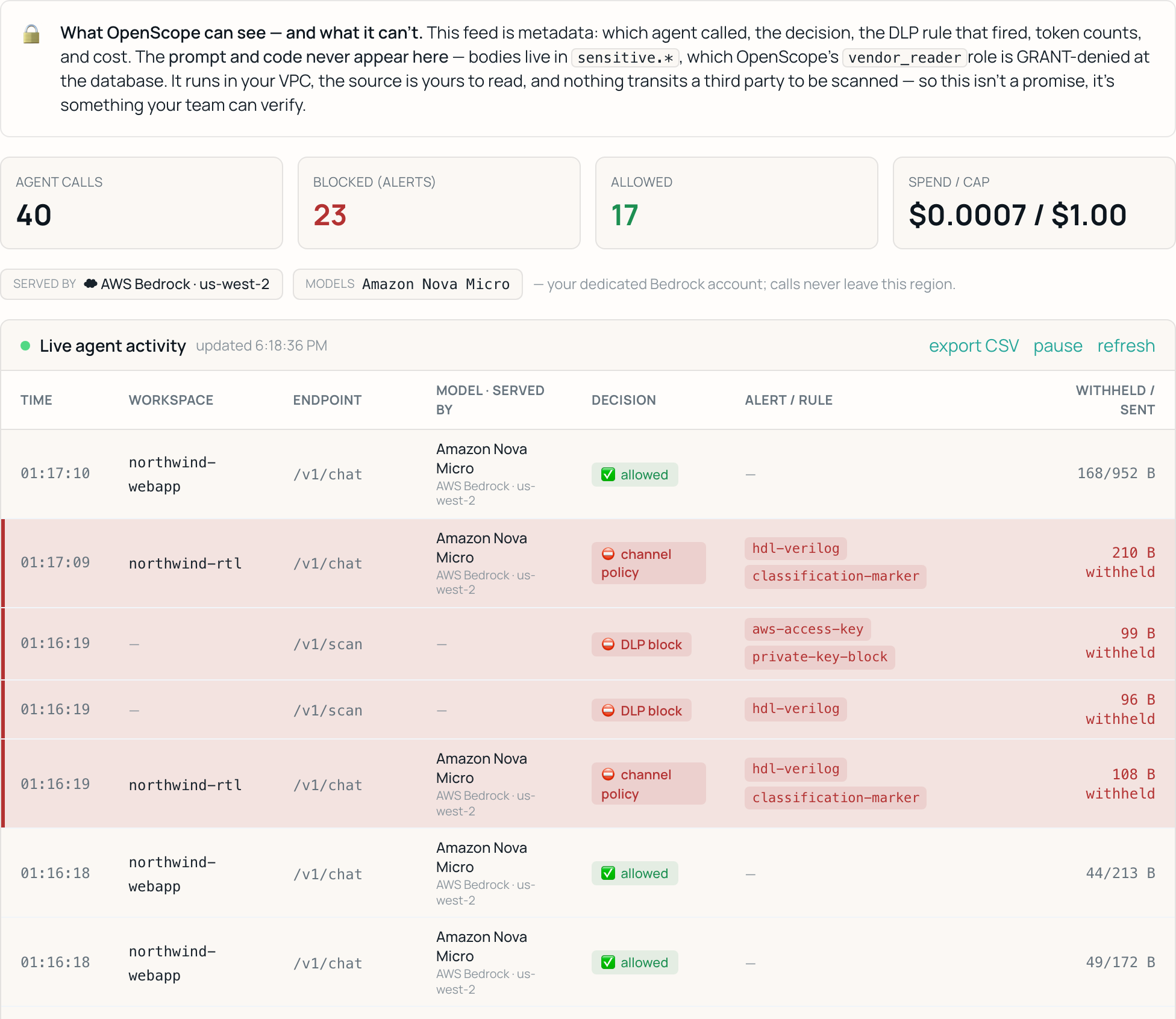
Every coding-agent call, as it happens: which agent, the decision, the DLP rule that fired, the model it was served by, token counts and cost. The prompt and code never appear here, bodies live where OpenScope's own role is GRANT-denied at the database.
The feed is metadata, exportable to your SIEM. A block shows the rule and the bytes withheld; an allow shows the model and region it was served by. Your team gets the audit trail without anyone, including OpenScope, reading the prompt or the code.
A real Bedrock-class lineup, metered per model with unit price and cost, and a signed receipt for every call, so finance and security can reconcile spend without ever reading a prompt.
Your administrator curates the lineup, enable the models you want, turn off the expensive or low-quality ones; the router refuses a disabled model at the edge. Every call is metered by model and Ed25519-signed, so a receipt reconciles against your provider bill on its own.
The router runs in your VPC and nothing transits a third party to be scanned. OpenScope operators cannot read prompts or code, not because we promise, but because the database refuses the query and the IAM and schema GRANTs show the access never existed.
This is the difference from an edge-hosted gateway: scanning happens in yourperimeter, on infrastructure you own, source-available so you can audit exactly what it does. The demo lets an “OpenScope operator” role try to read prompt bodies, and shows Postgres refusing the query.
No proxy to babysit, no SDK to adopt. Set the base URL and key, and the agent your engineers already use is governed.
Point ANTHROPIC_BASE_URL at the router and pass your key, Claude Code is governed with no model name to set. opencode adds a custom provider in one config block.
Override the OpenAI base URL to the router's /v1 endpoint. Any model name works, unknown names are remapped to the demo default; a disabled model is refused at the edge.