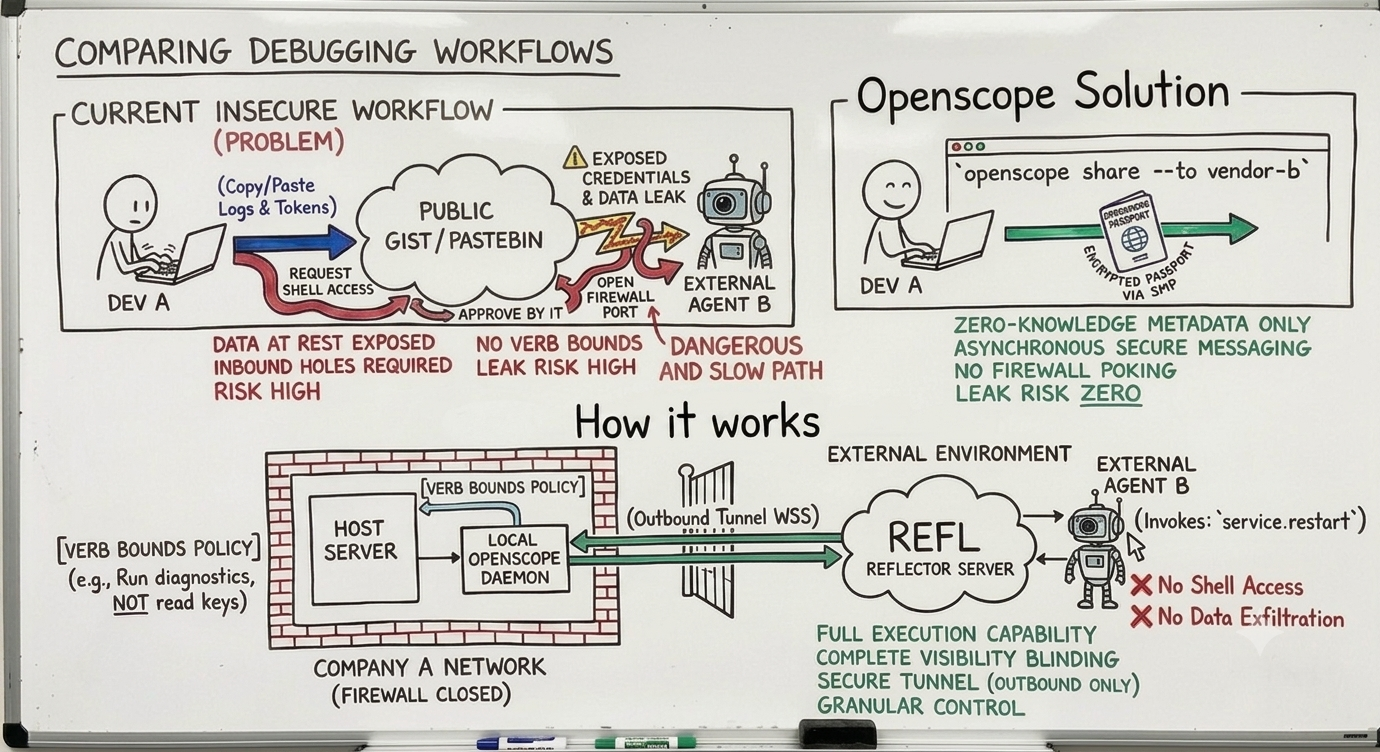
The static data leak
To give an outside agent context, developers paste raw logs, schemas, and stack traces — with tokens and keys baked in — into Gists and pastebins. Sensitive data sits at rest on the public web, indexed and cached.
When a vendor, contractor, or remote teammate — or their agent — needs to debug your closed environment, you shouldn't have to paste logs into a pastebin or punch a VPN hole. OpenScope lets you delegate a narrowed slice of your own actions over an outbound-only tunnel: they run the verbs you sanctioned, as you, for a few minutes, through a relay that can't read a thing.
External agents and contractors can't reach your internal network, so to unblock the work, teams fall back on two high-risk habits — and both trade safety for speed.
To give an outside agent context, developers paste raw logs, schemas, and stack traces — with tokens and keys baked in — into Gists and pastebins. Sensitive data sits at rest on the public web, indexed and cached.
To allow live work, IT provisions a temporary VPN or SSH credential that pierces the perimeter. The outsider — or their agent — inherits a full shell and broad, ambient authority: cat, rm -rf, lateral movement.
Both paths need a firewall change or an approval, and neither is scoped to the task at hand. The fast way to unblock the work is also the dangerous one.
You delegate a subset of your own verbs. Your daemon dials out to a relay it doesn't trust; the recipient connects from outside and gets exactly the actions you sanctioned — nothing else, and not a byte of raw access.
openscope share open delegates a narrowed slice of your own surface — specific verbs, with parameters pinned to the task.
It opens an outbound-only connection to the relay. No inbound ports, no firewall changes, nothing exposed at your network edge.
They run openscope-reflect-client with the handle, confirm your daemon fingerprint out of band, and see only the sanctioned verbs.
Each call executes under your identity and policy, every one logged. The session self-destructs at the TTL — 30 minutes, hard cap.
It is an ephemeral, signed delegation — a strict subset of your existing, root-owned grant. It can remove verbs and pin parameters; it can never widen your authority. That's the structural guarantee that makes handing it to an outsider safe.
A passport is derived from your live capability surface, then attenuated: pin parameters (service=web), drop every verb you didn't name. It can only remove from what you already hold — never add.
Every reflected call executes under your principal, through the same default-deny policy chokepoint. The authority lives in the daemon's session, not in the bytes the recipient holds — even a buggy passport can't exceed your standing grant.
The session is sealed to the recipient's registered key (--to <alias>), so only they can connect. Need an out-of-band handoff instead? --bearer issues an unbound handle you convey yourself.
The capability surface is the only thing exposed. Everything underneath it stays out of reach, and the relay in the middle is blind by design.
The relay is a blind byte-pump. It pairs the two legs by an unguessable rendezvous id and forwards opaque, end-to-end-encrypted frames between them. It never holds the channel keys, so it can't read — or archive — what flows through. Frames live in memory and are dropped as they're delivered, so there's nothing at rest on third-party infrastructure.
Your daemon authenticates to it with a deployment token; the recipient authenticates by possessing the handle and a secret sealed to their own key. Self-host the relay, or point at a hosted one — either way it sees only ciphertext.
You issue the session from inside the closed network; the recipient connects from anywhere with the handle you hand them.
openscope share open \
  --agent you \
  --verb ssh.tail_logs:service=web \
  --verb ssh.restart_service:service=web \
  --to vendor-b --ttl 30m

# share list / share extend / share revoke manage live sessions
openscope-reflect-client --passport <handle>